At Kafulu Primary School in Area 22 in Lilongwe, scratched graffiti stretching across classroom blocks and the school perimeter welcomes you.
The untidy wall art includes names, symbols and gang markings scrawled in bold ink.
For pupils, this is the first thing they see each morning before getting to class.
These are not just scrawls, but signs of intrusion and insecurity.
What should be a safe and welcoming learning environment reflects a school left exposed to people with little or no regard for teaching and learning.
Last year, thugs assaulted a Standard Five pupil and left him unconscious for two hours for confronting a group suspected of stealing toilet slabs at the school.
“He collapsed for two hours,” says school committee chairperson Nelson Nyson. “He shouted for help when he saw some people ransacking the latrines.”
The pupil survived, but the incident left a chilling effect: Constrained public schools are not entirely safe spaces for teaching and learning
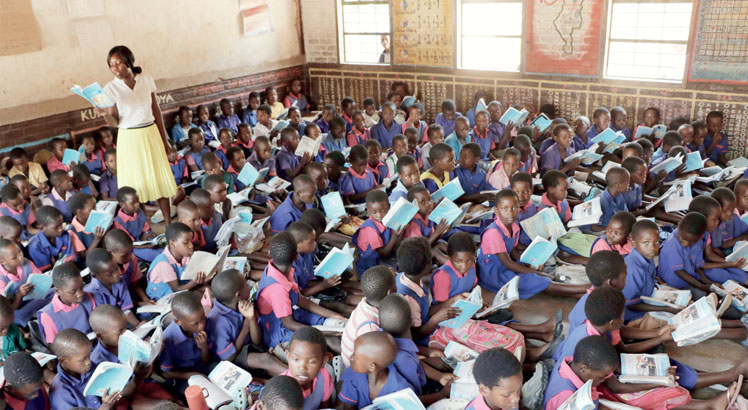
Opened in 1991, Kafulu Primary School lies close to Capital Hill in Area 30 National Police Headquarters.
Yet proximity to the seat of government and the epicentre of national security apparatus has not shielded it from repeated attacks.
The school has had 11 headteachers over the years and their reports echo the worsening security concerns.
Current head teacher Fellen Chongwe says vandalism is getting out of hand.
She narrates: “Several school assets have been stolen, even in broad daylight. Among the losses, 12 computers we received in 1994 vanished in 2012 and a satellite TV dish donated by China Aid in 2020 disappeared.
“A solar power system installed last year lasted barely two months. Thieves came, intimidated people on site and went away with the solar equipment.”
The security lapses at Kafulu is not isolated. Across Lilongwe, there are similar reports from Biwi Ngwenya and Njewa primary schools.
Intrusion has become increasingly common even in secondary schools.
Beyond the capital city, the problem is prevalent across the country.
Thieves last month broke into Namkumba Community Day Secondary School (CDSS) in Blantyre Rural and killed a night guard before disappearing with assorted items. In a separate incident, another guard had his arm hacked by unknown thugs.
Electricity Supply Corporation of Malawi connected Namkumba CDSS to the national grid in 2012, but 450 students and 23 teachers at the institution have never seen the light as thieves looted copper wiring, sockets and meters soon after installation.
They also looted laboratories, stripping them of water taps and other plumbing accessories, denying students hands-on experiments and practicals during science lessons.
Head teacher Gift Loppah says Milare Police Unit has taken some cases to court, but the plunder persists.
“We have reported these cases several times, but the thefts continue,” he says. “We envisioned electricity helping learners study beyond sunset to improve their academic performance, but that hasn’t been possible.”
Malawi Government rolled out free secondary education in January 2026 for equal access to quality teaching and learning regardless of economic status.
However, Civil Society Coalition for Education executive director Benedicto Kondowe says rising looting and violence undermine the intended policy impact.
“While the government introduced free secondary education to expand access, increasing vandalism and violence in schools created unsafe and poorly resourced environments, forcing some learners out while others struggle to learn effectively. Ultimately, this defeats the policy goal,” he argues.
Interestingly, the Ministry of Education, Science and Technology is aware of “the serious concern affecting learner safety and the quality of education”.
The ministry’s spokesperson Lilly Kampani, said vandalism remains a serious concern affecting both safety and learning conditions.
She said government values community involvement and preventive measures, such as fencing and improved security systems, to tackle the challenge.
“While the ministry continues promoting community participation in safeguarding education infrastructure, we urged schools to report incidents promptly to law enforcement,” Kampani says.
However, Kondowe says the plunder d reflects deeper systemic breakdown.
“Security is often treated as an afterthought, with limited investment, weak community ownership and minimal deterrence,” he states. “Currently, many schools lack basic protection such as fencing and well-trained guards and secure storerooms, making them easy targets. A durable response must combine security, accountability and community ownership.”
The 2024 Annual School Census shows 83 percent of primary schools are government-run, as is the case with three in four secondary schools.
According to the findings, only 21 percent of 1 525 secondary schools nationwide were fenced, highlighting an extensive security gap.
However, the looting constitutes a huge setback to constrained schools where children grapple with inadequate resources for teaching and learning as well as lighting, water, sanitation and hygiene.